



Elections
https://npr.brightspotcdn.com/dims3/default/strip/false/crop/3300×3233+0+0/resize/400/quality/85/format/webp/?url=http%3A%2F%2Fnpr-brightspot.s3.amazonaws.com%2Fc9%2F8a%2Fe5e00fe4494caf61b4b7c3356cbf%2Fap19266617691776.jpg 400w, https://npr.brightspotcdn.com/dims3/default/strip/false/crop/3300×3233+0+0/resize/600/quality/85/format/webp/?url=http%3A%2F%2Fnpr-brightspot.s3.amazonaws.com%2Fc9%2F8a%2Fe5e00fe4494caf61b4b7c3356cbf%2Fap19266617691776.jpg 600w, https://npr.brightspotcdn.com/dims3/default/strip/false/crop/3300×3233+0+0/resize/800/quality/85/format/webp/?url=http%3A%2F%2Fnpr-brightspot.s3.amazonaws.com%2Fc9%2F8a%2Fe5e00fe4494caf61b4b7c3356cbf%2Fap19266617691776.jpg 800w, https://npr.brightspotcdn.com/dims3/default/strip/false/crop/3300×3233+0+0/resize/900/quality/85/format/webp/?url=http%3A%2F%2Fnpr-brightspot.s3.amazonaws.com%2Fc9%2F8a%2Fe5e00fe4494caf61b4b7c3356cbf%2Fap19266617691776.jpg 900w, https://npr.brightspotcdn.com/dims3/default/strip/false/crop/3300×3233+0+0/resize/1200/quality/85/format/webp/?url=http%3A%2F%2Fnpr-brightspot.s3.amazonaws.com%2Fc9%2F8a%2Fe5e00fe4494caf61b4b7c3356cbf%2Fap19266617691776.jpg 1200w, https://npr.brightspotcdn.com/dims3/default/strip/false/crop/3300×3233+0+0/resize/1600/quality/85/format/webp/?url=http%3A%2F%2Fnpr-brightspot.s3.amazonaws.com%2Fc9%2F8a%2Fe5e00fe4494caf61b4b7c3356cbf%2Fap19266617691776.jpg 1600w, https://npr.brightspotcdn.com/dims3/default/strip/false/crop/3300×3233+0+0/resize/1800/quality/85/format/webp/?url=http%3A%2F%2Fnpr-brightspot.s3.amazonaws.com%2Fc9%2F8a%2Fe5e00fe4494caf61b4b7c3356cbf%2Fap19266617691776.jpg 1800w” data-template=”https://npr.brightspotcdn.com/dims3/default/strip/false/crop/3300×3233+0+0/resize/width/quality//format/format/?url=http%3A%2F%2Fnpr-brightspot.s3.amazonaws.com%2Fc9%2F8a%2Fe5e00fe4494caf61b4b7c3356cbf%2Fap19266617691776.jpg” type=”image/webp”>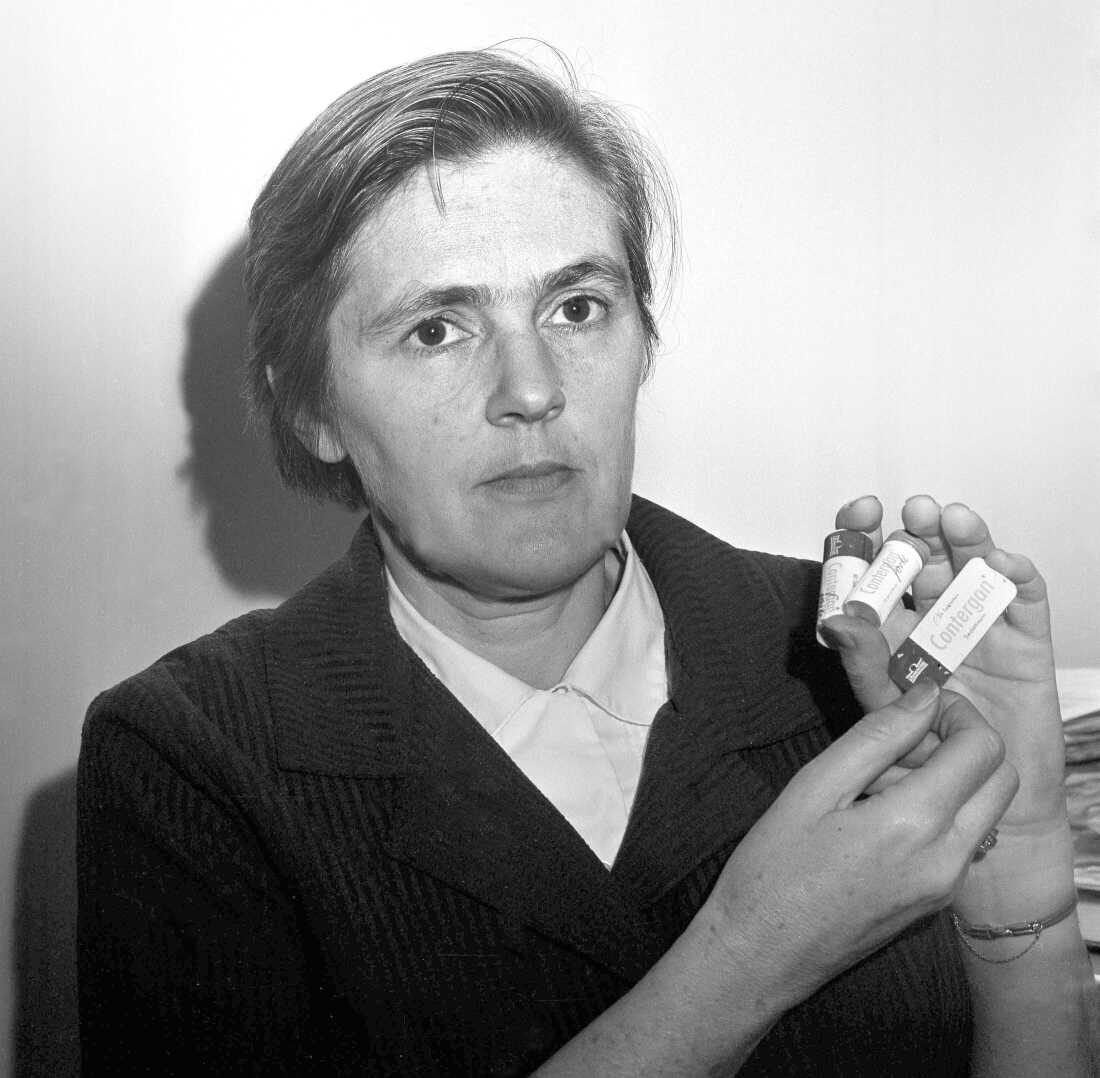
Dr. Frances Oldham Kelsey, then-pharmacologist at the Food and Drug Administration, holds 3 plans of Contergan, the German trademark name for thalidomide, on Oct. 15 , 1962. Kelsey avoided the FDA from authorizing the drug for basic usage in the United States. William J. Smith/AP
conceal caption
toggle caption
William J. Smith/AP
When Cincinnati-based pharmaceutical business William S. Merrell requested Food and Drug Administration approval for a German-made sedative in late 1960, it anticipated the application to cruise through the procedure and be on shop racks in time for Christmas.
The drug, thalidomide, was not authorized that year or the next. A consistent medical customer at the FDA kept the drug from being authorized for basic usage. Dr. Frances Oldham Kelsey’s actions basically altered the firm’s screening and approval procedure, resulting in the robust guidelines that exist today.
President John F. Kennedy openly applauded Kelsey for sparing “us this terrible human tragedy which has been visited on families in Germany.”
Other than that wasn’t completely real.
Medical professionals were currently offering thalidomide to countless U.S. clientsconsisting of pregnant ladies. Some kids whose moms were provided the drug throughout pregnancy were born with badly warped limbs.
Those kids are now grownups, and they desire the federal government to officially acknowledge their presence.
“We go to doctors today who say it didn’t happen here in the United States. Oh yeah, it did,” stated Gwen Riechmannwho was born with phocomelia, the signature reduced limb defect triggered by thalidomide.
Phocomelia is unusual, however somewhat more typical outside the United States in nations such as Britain and Germany, where thalidomide was more commonly offered.
When Riechmann’s mom was pregnant with her in the early 1960s, the physician offered her a brand-new sedative to assist with her queasiness. She was unintentionally part of an uncontrolled U.S. scientific trial for thalidomide.
Merrell gave out countless unlabeled dosages, informing medical professionals it was completely safe for dealing with a series of problems from sleeping disorders to early morning illness, according to Jennifer Vanderbes, whose book Marvel Drug information the history of thalidomide. She stated the business didn’t need the physicians to track the medication or report back on adverse effects.
“This was such a sloppy investigation,” stated John Swann, retired FDA senior historian.
As the FDA drilled into Merrell’s records, Swann stated, the quantity of thalidomide that could not be represented stood out.
“When you have a problematical product, you trace back to where it’s been distributed,” Swann stated. When the FDA did that, it discovered, “and certainly the company had admitted, that there was just a great deal that was unaccounted for.”
“It’s probably the most iconic toxic drug of all time because of its signature injuries,” Vanderbes stated. “It transformed the FDA because it made it clear that more significant and serious drug testing had to take place before drugs were released on the market.”
The medical professionals didn’t inform the females they were taking thalidomide or file it in their medical records, Vanderbes stated. The females “had no slips of paper that showed their prescription. They had no bottles with a label.”
What numerous did have actually were kids born with truncated limbs.
Even after these infants were born, and even after the clinical neighborhood comprehended the threats of thalidomide, physicians did not expose that they had actually offered their clients the drug, Vanderbes stated. Some females were particularly informed they had actually not taken it.
Years later on, much of the females’s kids were likewise informed they could not be thalidomide survivors due to the fact that their medical professionals thought the United States had actually left the thalidomide scandal.
Vanderbes price quotes there might be around a hundred U.S. survivors.
Swann, the previous FDA historian, stated it’s tough to understand a precise variety of American-born infants whose moms took the drug, however it was definitely more than the 17 officially acknowledged by the FDA.
In 2018, Riechmann co-founded the advocacy group USA Thalidomide Survivors. The group of approximately 100 individuals, that includes allies along with survivors, is pressing Congress to pass an expense that would formally acknowledge American thalidomide survivors and provide each $150,000, with the possibility of extra cash in the future.
“The U.S. is the only country that has not provided any kind of support or even recognition that they have thalidomide survivors,” she stated. “We are looking for, first, recognition that, yes, we do exist. And then, secondly, support.”
Survivors are aging, and their health is weakening, Riechmann stated, however they can’t quit– even if they likewise can’t wait long.
Discover more from PMN S.P.O.R.T.S - A PRIME MEDIA NETWORK BRAND
Subscribe to get the latest posts sent to your email.