


An engineer and home-energy lover checks out the Anker Solix S5000 in California hillside, and files all of it in a deep dive evaluation for ESS News.
Anker revealed the S5000 on October 9. I checked a pre-release system in Northern California, concentrating on charging, functional capability, idle intake, mobility, and backup throughout a multi-day power interruption.
Continue reading to see how my father-in-law’s famous homemade pasta sauce endured a genuine three-day interruption, and what my mother-in-law stated!
(Previously, I likewise evaluated out the Anker Solix E10 back in May, a whole-home backup, and the Anker Solix S2000 .)
Requirements
The S5000 is a wheeled power station with 5,024 Wh of LFP storage and a 4,500 W inverter that provides both 120 V and 240 V.
According to Anker, the L14-30R keeps providing 240 V while the S5000 charges from a 120 V outlet or generator. I didn’t check that.
Source: Anker
Charging
The S5000 charges 4 methods: A/C, solar, Anker’s Smart Generator, and a lorry generator. I evaluated a/c and solar.
A/C
I ran 2 complete 0– 100%charges from a basic U.S. 120 V, 60 Hz outlet with an energy meter at the wall: one at the app’s 1,800 W optimum and one at 1,000 W. I didn’t test 240 V charging 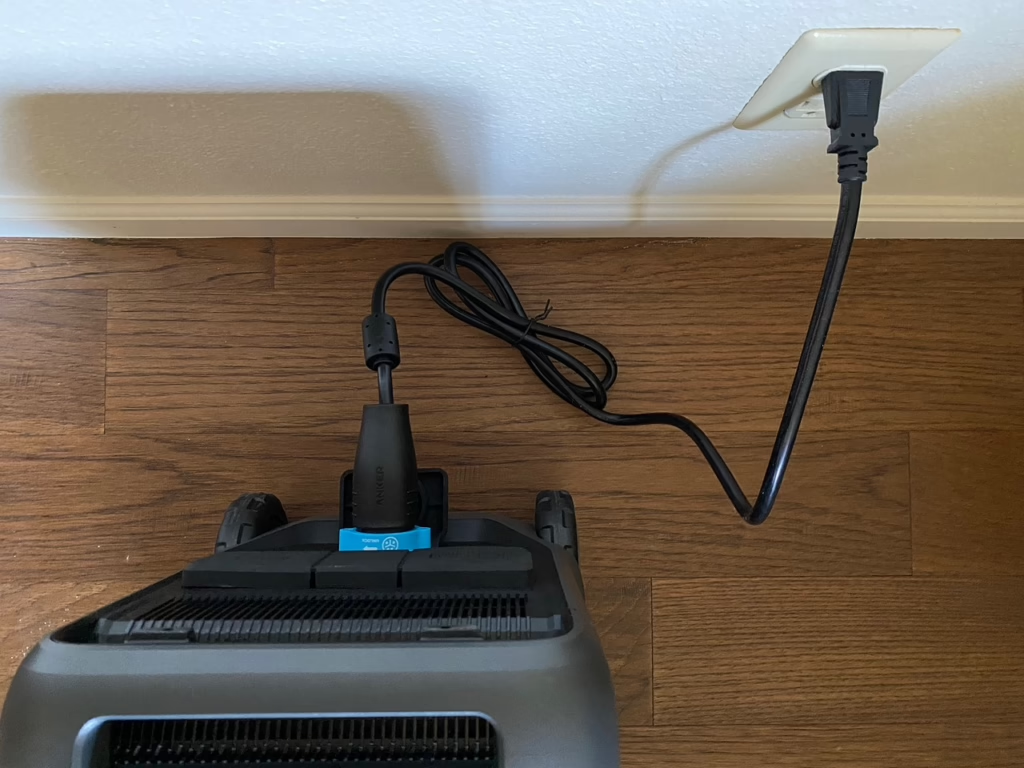 .
Air conditioning charging from a basic 120 V outlet. The a/c input, on the rear beside the wheels, utilizes an E10-style locking adapter, though the receptacle specifies to the S5000 and does not take E10 cable televisions.
1,800 W setting
Wall draw held at about 1.79 kW for 2 h 49 minutes, then stepped down to about 1.43 kW for the last 50 minutes. That matches a footnote in Anker’s specifications: at 120 V, the 1,800 W rate is restricted to under 3 hours when present surpasses 12 A. The 1.43 kW phase sits simply under 12 A, or 80%of a 15 A circuit.
That last provided 19 %of the charge. Balanced over the complete charge, the S5000 drew about 1.7 kW from the wall, not 1.8 kW.
1,000 W setting
Wall draw remained flat at about 1 kW for the entire charge, without any step-down. Compared to the 1,800 W setting, the charge took 65% longer and utilized 1.7% less energy from the wall. The lower setting works on a shared circuit or a little generator, however the performance gain is little.
Other observations
On both charges, the last taper at 100% lasted just 1– 1.5 minutes. The app and screen checked out lower than the wall meter, and the space grows with charging power. I do not understand where in the power course the S5000 takes its reading, so I can’t associate the space to battery charger losses. Each 1% of shown charge took 61– 62 Wh from the wall.
The app throughout the 1,800 W-setting charge, reporting 1.677 kW of input while the wall meter checked out 1.79 kW.
Charging was extremely peaceful, remarkably quieter than the smaller sized S2000. Anker notes sound as under 30 dB without mentioning conditions; I didn’t determine it. There was a faint warm-electronics odor throughout the very first couple of charges, though it never ever troubled me.
Solar
The S5000 has 2 solar inputs, ranked for 3,000 W integrated:
- High-voltage input: 16– 165 V, 17 A max, 2,000 W max, for panels wired in series. The consisted of high-voltage solar adapter links to MC4 adapters.
- Low-voltage input: XT-60i port; 11– 60 V, 17 A max, 1,000 W max, for a single panel or panels in parallel. Parallel connections require a low-voltage solar adapter, such as an MC4 Y-combiner, offered individually. This input is shown the generator battery charger.
I wired 2 Anker Solix PS400 panels, each ranked 400 W at 48 V and 8.33 A, in series to the high-voltage input. The PS400s are rugged and paired well with the S5000: connection was easy, and output peaked at 680 W on a bright October day, 85% of their combined score of 800 W. The panels, not the input, set that limitation.
The S5000 with 2 PS400 panels.
The high-voltage PV input, with the low-voltage input listed below it. The panel to its left is simply a blank cover.
Smart Generator
The S5000’s DC input accepts as much as 4,500 W from Anker’s Smart Generator, a multi-fuel AC/DC generator; Anker rates charging into a single S5000 at 4,300 W. The very same port links growth batteries.
The DC input utilizes the exact same port design as the Anker Solix E10. These ports work well when seated, however I’ve seen their plastic locking tabs break off. On the S5000, the receptacle sits rather close to the ground, and its orientation directs the cable television downward with minimal clearance.
The S5000’s DC input, with its A, B and C inputs above a 16-pin adapter.
The E10’s Smart Generator cable television would not totally seat in the S5000. The receptacle’s non-circular A, B and C inputs appear to avoid complete insertion. I’m unsure whether that’s particular to this pre-release system or something else, however it suggested I could not evaluate generator charging. It’s a pointer of the threat with exclusive ports: cable televisions from the very same item household that look interchangeable might not be.
The E10’s Smart Generator cable television, with the orange seal still exposed: the plug stops brief of complete insertion in the S5000.
Generator
Anker’s 800 W Alternator Charger, offered individually, wires to a car’s 12 V battery and charges the S5000 through the low-voltage input while the engine runs. It’s targeted at RVs and vans and I didn’t check this performance.
Functional capability and big salami
In my screening, the app reported 4.87 kWh provided on a complete discharge, 97% of nameplate. Versus the 6.24 kWh drawn from the wall to charge it at the 1,800 W setting, that’s a 78% big salami. I didn’t meter the output, so the capability and round-trip figures count on the app’s discharge reading.
Anker rates release effectiveness at 96% at 1,000 W and 90.5% at 4,500 W. Those figures cover just the battery-to-outlet action; a big salami likewise consists of the losses from charging.
Idle and standby draw
On battery, with the 120 V output on and absolutely nothing linked, the S5000 lost 5% state of charge in 24 hours. That’s about 10 W, constant with Anker’s 8.8 W figure considered that the display screen just reveals entire portions. That exercises to about 20 days on a complete battery. Anker rates standby at 21 days (512 hours) at 120 V and 14 days (341 hours) at 240 V.
Plugged in and complete, the S5000 drew about 7 W from the wall, or about 60 kWh ($18 at 30 cents/ kWh) over a year on the battery charger.
Dealing with it
Interruptions and genuine loads
All discharge screening utilized the 120 V outlets; I didn’t evaluate the 240 V output. A portable air conditioning unit ran for more than 4 hours at about 1 kW without concern.
Throughout a PG&E Public Safety Power Shutoff (PSPS), when the energy cuts power to minimize wildfire danger, the S5000 ran my in-laws’ big fridge, plus phones and other little gadgets, for 61.5 hours, going from 100% to 18%.
My father-in-law’s famous homemade pasta sauce made it through, and my mother-in-law summed it up: “That was remarkable, it was Wednesday night, Thursday night, Friday night and it’s still going!”
The S5000 established beside my in-laws’fridge ahead of the PSPS occasion.
Utilizing 82%of the battery exercises to about 4 kWh, based upon the 4.87 kWh full-discharge figure. That’s approximately 65 W usually, consisting of the S5000’s own draw. At that rate, a complete charge would last about 75 hours. Anker ranks the S5000 at approximately 86 hours for a 700 L refrigerator alone at 25 ° C, so my outcome, with additional gadgets on the load, is close, and mileage might differ if the refrigerator or freezer aren’t opened at all.
Construct and managing
The S5000 is sturdily constructed, and its durable telescoping deal with makes it simple to wheel around on flat ground. On lawn or rough ground, it gets unsteady and is vulnerable to tipping; it’s just 27 cm broad. At 44 kg, it’s difficult for a single person to raise; 2 individuals, as the guideline card suggests, can handle stairs or filling it into a vehicle.
Where it fits with the Anker Solix E10
Anker’s home backup items follow 2 tracks: completely set up whole-home systems and portable power stations. The E10 is the very first: an inverter, stackable 6,144 Wh B6000 battery modules, and a Power Dock that deals with transfer changing and per-circuit control. The S5000 is the 2nd: it plugs in where it’s required, or feeds a home through a transfer switch or inlet box on its L14-30R outlet.
The 2 share one piece of hardware: the Smart Generator, which can charge either one. Beyond that, the S5000 has no combination with the E10 system, consisting of the Power Dock.
The line in between them needs to be drawn someplace, and the S5000 sits right on it: it holds 82% of what a B6000 module does. It can currently support chosen circuits through an inlet box, however Power Dock assistance would include automated switchover and let it function as E10 storage you can disconnect and take in other places. It isn’t ranked for outside usage like E10 devices, however a Power Dock in a garage would be within reach.
Who it’s for
The S5000 is portable, it has wheels, and it withstands screening. At 44 kg and 5 kWh, it’s about as much as you can load into a high-output power box.
For portable home backup, it can run a refrigerator and fundamentals from its outlets, or feed picked family circuits at 240 V through an inlet box. Much heavier loads like central air conditioning or electrical cooking would drain pipes 5 kWh rapidly, which is where Anker’s growth batteries can be found in: about 5 kWh each, approximately 30 kWh in overall. I didn’t check them.
Specialists and tradespeople get 4,500 W constant and 8,000 W peak, enough on paper for a lot of corded tools, plus 240 V for much heavier ones. On a task website, the weight and the capacity for tipping on rough ground are the larger issues. A store vac drawing about 1 kW ran without problem, however I didn’t check other tools.
For locations with long blackouts, or anybody who wishes to be prepared, the series of charging alternatives sticks out: solar or a generator can keep topping up a battery that currently runs a refrigerator for days.
A recreational vehicle can plug into the S5000’s TT-30R, with the battery covering high loads like an ac system. It does not have the 12 V DC output typical in RVs and comparable setups.
For standard outdoor camping, it’s overkill: a two-person lift, with far more output than a lot of campsite loads require.
In lots of methods, the S5000 is a larger-capacity S2000 with 240 V output. One little distinction that I discovered beneficial is that the S2000 has outlets on both the front and back, which I like, while all of the S5000’s outputs are on the front.
2 S2000s are an alternative worth thinking about. Together they hold about 4 kWh, in 2 16 kg systems that can being in various locations, each ranked at 1,500 W constant and 3,000 W peak. The S5000 makes more sense when a single load requires more than 1,500 W, when you require its 240 V and TT-30 outlets, or when you just desire longer runtime from one system.
Summary
The S5000 provided almost all of its ranked capability and kept a big fridge going through a genuine multi-day power failure.
At the $2,499.99 launch rate, it costs simply under $500 per nameplate kWh; at the $3,599.99 MSRP, about $720.
S5000 pros:
- 4.87 kWh provided, 97% of nameplate (app-reported)
- 61.5 hours of refrigerator backup throughout a genuine PSPS, beginning at 100% and ending at 18%
- About 10 W idle on battery in my screening
- 4,500 W output at 120 V and 240 V, with 4 methods to charge
- Peaceful charging and a strong develop
S5000 cons:
- 44 kg, a two-person lift, and susceptible to tipping on rough ground
- 78% big salami in my screening (app-reported output)
- The E10’s Smart Generator cable television didn’t fit
- No 12 V DC output or combination with the E10 environment
5 kWh on wheels goes a long method: through 3 nights without power, it did what it required to do when put under a genuine test, which was keeping the fridge/freezer cold and the phones charged, and parents-in-law more than delighted.
In previous tests, I’ve stated storage redeems normalcy, and the S5000 was portable enough for me to take it to where it was required to provide that ‘typical’ sensation throughout a considerable power failure.
Having the ability to assist yourself is a win, however assisting others too is where the genuine heartfelt impact is available in.
Andrew Riha is a computer system engineer based in Northern California, where he blogs about home energy and other technical pastimes. This evaluation shows the author’s individual experience.
From ESS News
The views and viewpoints revealed in this short article are the author’s own, and do not always show those held by pv publicationThis material is secured by copyright and might not be recycled. If you wish to comply with us and wish to recycle a few of our material, please contact:
Discover more from PMN S.P.O.R.T.S - A PRIME MEDIA NETWORK BRAND
Subscribe to get the latest posts sent to your email.



