Economy news
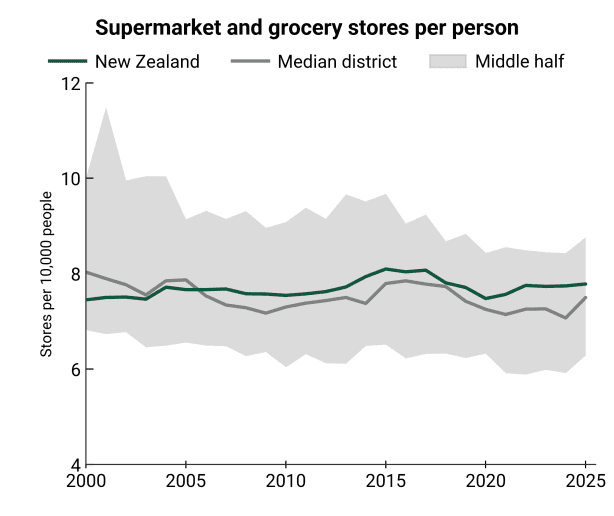
New Zealand has high levels of concentration in the grocery sector. The 2 primary grocery store chains hold 82 percent of the marketplace, down just a little from 84 percent in 2020 in spite of continuous attention.
The Commerce Commission has actually highlighted that New Zealand grocery stores likewise appear to have actually high margins compared to those in other nations.
In its newest grocery report, it kept in mind Foodstuffs North and South Islands had EBIT margins of more than 6 percent, second-highest in its international contrast and ahead of Coles, Walmart, Tesco, Sainsbury and Carrefour.
Woolworths had a margin of 1 percent and includes short on the table, although that consists of current considerable financial investment made by the grocery store chain in rebranding.
The existing duopoly circumstance, in which New Zealand co-operatives Foodstuffs North Island and South Island take on Woolworths, has actually remained in location given that the early 2000s, when the Commerce Commission offered clearance for Progressive Enterprises’ acquisition of Woolworths.
OECD information reveals no clear influence on the speed of boost in food costs before or after this amalgamation.
Provided

Provided
Provided
Westpac primary economic expert Kelly Eckhold stated New Zealand’s food costs had actually been increasing at a rate that put them someplace in the middle of the series of nations we may typically compare ourselves to.
He stated the issue was most likely that earnings in New Zealand had actually not increased as rapidly. “So that’s where people are feeling the pinch.”
Simpleness chief financial expert Shamubeel Eaqub stated there were durations where New Zealand’s rate of food inflation had actually increased dramatically. “Sometimes that is related to weather conditions because a lot of hte fresh food will be local.
“Since we’re in the Southern Hemisphere we get somewhat various weather condition patterns and effect on foods … however total food costs in New Zealand versus sophisticated economies appear to go on sort of the very same [track]It does not suggest we’re not all being gouged however we can’t see it in the information.”
University of Auckland senior lecturer in marketing Drew Franklin said while inflation might not have run ahead of the rest of the world, it did not mean the lack of competition had not affected prices.
“Any 2 nations can see their costs increase at precisely the very same rate while among them pays substantially more than the other the entire time. It’s likewise worth keeping in mind that any contrast with Australia is a contrast with another extremely focused market, controlled by Coles and Woolworths, so it’s possibly not a reasonable standard for what a competitive market would appear like.
“When the Commerce Commission compared actual price levels and profits in its 2022 market study, it found New Zealand was the fifth most expensive grocery market in the OECD in 2017 and that between 2015 and 2019 the major supermarkets earned returns on capital more than double its central estimate of a normal return in a competitive market. Its latest annual grocery report found little change since then in market concentration or supermarket margins.”
Eckhold stated there was not likely to be any reform that was a silver bullet to make food more budget-friendly.
“It’s important to understand that most of this debt is about a more marginal impact on prices. If you did make the market more competitive and if margins in supermarkets declined… you might be looking at reducing the profits by half in the sector but that’s a small proportion of the total price that you’d pay at the supermarket.”
Eckhold stated it might be possible to develop a little more affordable rates or a broader item offering however it would take some time. “Restructuring is quite disruptive for the industry, would have considerable costs for the industry and could actually result in higher prices for consumers for a while because competition might not appreciably change for a while.
“I believe individuals are searching for a response to the cost-of-living issue however I do not believe grocery store reform is the response.”
He said it was desirable to promote more competition in any part of the economy.
“What issue are we actually attempting to attend to here? If it’ the expense of living, I’m not positive that what’s being talked about here is actually going to significantly move that quite.”
Sign up for Money with Susan Edmundsa weekly newsletter covering all the important things that impact how we make and invest cash.
Discover more from PMN S.P.O.R.T.S - A PRIME MEDIA NETWORK BRAND
Subscribe to get the latest posts sent to your email.