


Cybersecurity
(Sept. 30, 2026/ JNS)
This is the very first post in a brand-new JNS series, “Made in Israel,” highlighting Israeli clinical and technological developments that are making an effect all over the world and discussing the science behind them.
In February 2021, black swellings of tar started cleaning onto beaches along Israel’s Mediterranean coast. The contamination ultimately impacted a big stretch of the eastern Mediterranean coastline, leaving beaches covered with petroleum residue and triggering a significant clean-up effort. For a nation with just about 195 kilometers of Mediterranean shoreline, and much of its population and crucial facilities focused near it, the episode was a suggestion that an oil spill far offshore can rapidly end up being an issue on land.
The very first hours after such a spill are frequently a race versus the sea itself. Many oils drift, spreading out throughout the surface area while winds and currents bring them far from the point of release. Responders can surround parts of the slick with drifting barriers and after that utilize specialized vessels to skim oil from the surface area. Other products can be released to soak it up. Waves, currents and rough weather condition make complex the work, and the further the slick spreads, the more hard it ends up being to include.
Even if containment succeeds, responders right away deal with a more difficulty: What occurs to the oil later?
Mechanical clean-up typically eliminates petroleum from the sea instead of ruining it. Oil gathered by skimmers should be kept, separated from water and ultimately recycled or disposed of. Oil-soaked clean-up products position a comparable issue. Other techniques decrease the requirement for disposal while presenting their own ecological compromises. Chemical dispersants break a slick into much smaller sized beads that get in the water, while regulated burning can ruin part of a surface area spill under ideal conditions. Each has its own function and constraints.
Scientists at Ben-Gurion University have actually been dealing with a various technique: a product created not just to catch petroleum however to assist nature simplify later. In lab experiments, the scientists revealed that these 2 procedures– physical capture and biological deterioration– might be integrated.
To comprehend how, it assists to start with the uncommon product at the center of the system: a nearly weightless, extremely permeable strong efficient in pulling often times its own mass in petroleum out of water.
A sponge to clean up the oceans
The product at the center of the Ben-Gurion University system is an aerogel, a strong constructed around an extremely open tiny structure. Instead of looking like a thick block, an aerogel is more like a fragile three-dimensional structure filled primarily with void. That makes it incredibly light while offering a large internal surface area on which other compounds can gather.
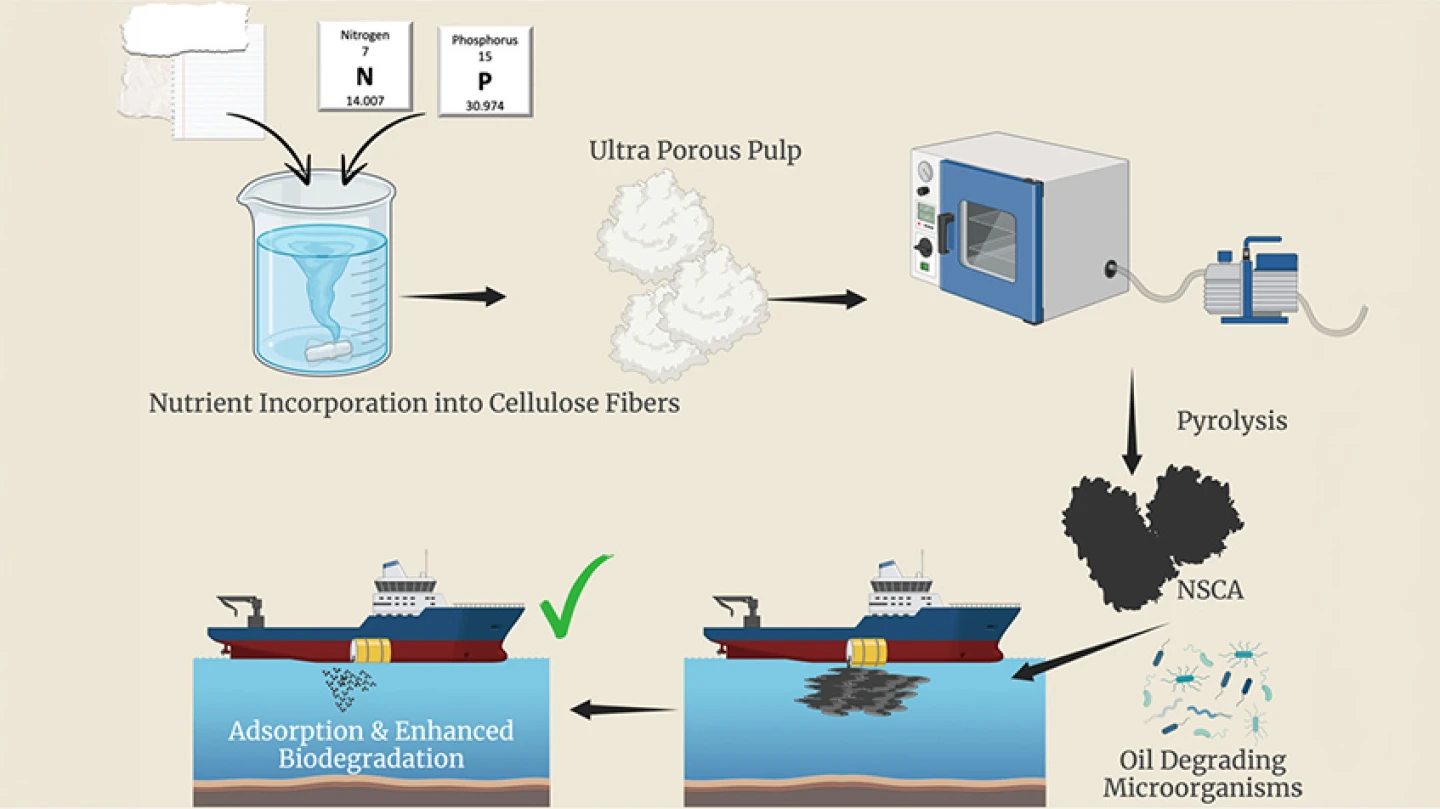
The scientists developed theirs from cellulose, the structural product discovered throughout plants and familiar from items such as paper. The cellulose is transformed into a carbon-rich, extremely permeable aerogel, producing a product with an important home for oil-spill clean-up: It highly withstands being moistened by water.
That difference matters since an oil adsorbent released at sea deals with an apparent obstacle: It is surrounded by significantly more water than petroleum. A beneficial product should for that reason do more than just absorb liquids indiscriminately. The carbonized aerogel is developed so that water mainly remains outside while petroleum spreads through and hold on to its permeable structure.
In lab tests, that structure showed extremely reliable. Under the best-performing preparation conditions reported in the 2026 research study, one gram of the nutrient-supplemented aerogel adsorbed about 78 grams of petroleum, approximately 80 times its own mass.
The number stands out, however it is not, by itself, the primary clinical advance. Carbon-based cellulose aerogels efficient in using up big amounts of oil existed before this work.
The primary development depends on what the scientists contributed to the sponge– and in the microbes they hoped would discover it.

???????????? ‘???????????
A nursery for germs
Oil-eating germs might seem like something crafted for a lab, however they are currently part of the natural marine environment. Many microbes can utilize petroleum hydrocarbons as sources of carbon and energy, and after significant spills their populations can increase dramatically. Throughout the Deepwater Horizon catastrophe, for instance, scientists recorded the enrichment of native germs efficient in degrading hydrocarbons in polluted deep water.
The trouble is that oil alone does not offer those microorganisms whatever they require. Petroleum might all of a sudden supply a massive supply of carbon, however bacterial development likewise depends upon nutrients such as nitrogen and phosphorus. In some oil-contaminated environments, those nutrients end up being the restricting aspect: The microbes have plentiful fuel however inadequate of the other components needed to increase and stay active.
Researchers have actually attempted to resolve this issue before. After the Exxon Valdez spill in 1989, fertilizers were used to parts of the impacted coastline to promote naturally taking place oil-degrading germs, and subsequent research studies discovered that nutrient addition might speed up biodegradation.
The difficulty is shipment: Nutrients launched into open water can distribute or remove rather of staying where the petroleum and microorganisms in fact fulfill.
The Ben-Gurion group’s essential action was to develop that nutrient supply into the aerogel itself. Nitrogen and phosphorus were included into the carbonized product and, in lab tests, stayed bound to it instead of merely seeping away. The very same permeable structure that catches the oil likewise offers microbes a surface area on which to connect, bringing the petroleum, germs and nutrients into one location.
That combination appears to matter. In the scientists’ experiments, the nutrient-bearing aerogel increased both the rate and level of biodegradation compared to comparable aerogel without the included nutrients. The product for that reason does more than gather the spill: It produces conditions that assist biological clean-up start where the oil has actually been focused.
Looking towards the future
The scientists themselves beware not to provide the aerogel as a completed clean-up innovation.
“It operated in the laboratory. Now a business needs to be developed to check it in the sea,” Prof. Ariel Kushmaro stated in a September interview.
Kushmaro, who led the research study in addition to Dr. Danit Lisa Karsagi Biron at BGU’s Environmental Biotechnology Laboratory, approximated that useful advancement would still take years. He stated the next phase would be to evaluate the sponge’s efficiency in a contaminated marina.
“There is oil in every port,” he stated.
The sea is a far less flexible lab. The released experiments utilized synthetic seawater under regulated conditions. A genuine spill would subject the product to waves and currents, altering temperature levels and salinity, weathered mixes of petroleum and extremely various microbial neighborhoods.
Kushmaro stated the sponge was developed for usage beyond the lab which he anticipated it to carry out well in field tests.
“It takes in between 2 and 3 weeks for the oil to vanish. If the oil spill remains in the middle of the sea, it can be dropped from an airplane. The cellular product itself is eco-friendly. We do not think that waves, currents and altering temperature levels would hinder the clean-up,” he stated.
The aspiration, nevertheless, is wider than a lab presentation.
“We dream about the possibility that every ship will have the aerogel on board, so that if it triggers an oil spill, it can right away simplify. They can right away trigger it to break down before it triggers damage,” Kushmaro stated.
“Shell, the international British international energy and petrochemical business, has actually currently called us to request for info about it,” he included.
As industrial interest grows and screening relocations beyond the lab, the Israeli development now faces its crucial test. If it can browse the clinical and industrial difficulties ahead, the aerogel sponge might make the leap from a stylish clinical option to a useful piece of maritime facilities securing the world’s seas and oceans.
- Copy
Link copied
-
Email[
19659045] Print

Shimon Sherman is a writer covering worldwide security, Middle Eastern affairs, and geopolitical advancements. His reporting supplies thorough analysis on subjects such as the revival of ISIS, Iran’s nuclear aspirations, judicial reforms in Israel, and the developing landscape of militant groups in Syria and Iraq. With a concentrate on investigative journalism and professional interviews, his work provides important insights into the most important concerns forming global relations and security.
Discover more from PMN S.P.O.R.T.S - A PRIME MEDIA NETWORK BRAND
Subscribe to get the latest posts sent to your email.



