


Marathon
WASHINGTON–The Supreme Court will open its brand-new term Monday by hearing arguments on whether the oil and gas market might be required to pay damages for the scorching heat waves, wildfires and dry spells that are blamed on environment modification.
It’s a special concern the justices have actually postponed choosing for almost a years– and might do so once again.
California signed up with more than 2 lots blue states and towns in 2023 when it took legal action against the 5 biggest oil business, declaring “years of deceptiveness” over the threat of a warming environment.
They have actually “independently understood the reality for years however have actually fed us lies and mistruths to enhance their record-breaking revenues at the cost of our environment,” California Atty. Gen. Rob Bonta stated.
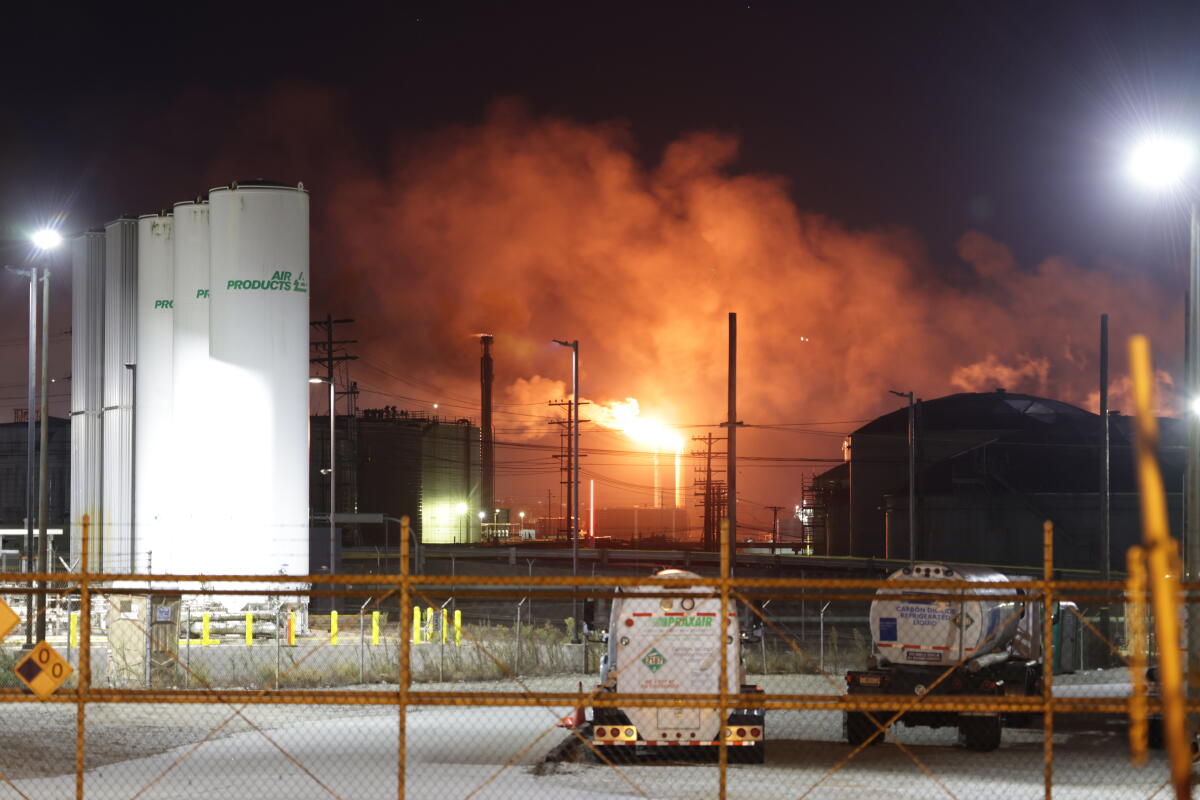
Fire and smoke increase at the Chevron Refinery in El Segundo in October 2025.
(Robbin Goddard/Los Angeles Times)
Such climate-change claims were patterned after the mass declares versus the tobacco and opioid markets. Both were implicated of hiding the risks of their very successful items.
The environment matches have actually stalled. Judges have actually been divided over whether these possibly substantial claims need to be chosen in federal or state court, and if so, under what law.
In 2015, Boulder County, Colo., won a 5-2 judgment in the state Supreme Court that enabled its 2018 match to continue as a claim of a public annoyance, an unfair enrichment or a civil conspiracy. These are described as “typical law” claims that are enduring and conventional however do not depend on a procedure authorized by the Legislature.
The Colorado judges likewise stated the climate-change matches are not “preempted” or obstructed by federal anti-pollution laws since the match for damages did not control greenhouse gas emissions.
The dissenters stated the state court was providing Boulder a “thumbs-up to serve as its own republic” to penalize the Exxon Mobil Corp. for the effect of “worldwide environment modification.”
Attracting the Supreme Courtthe oil business sounded the very same style.
“Boulder, Colorado can not make energy policy for the whole nation,” they stated. A judgment for the county would “license all 50 states and 10s of countless towns” to ask their regional juries to “enforce crippling liability” on the nonrenewable fuel source market, they informed the court.
The Trump administration took part assistance of the market’s appeal.
“Our federal system would break down if each state might deal with naturally nationwide or global issues by requiring its regulative prescriptions on the other 49,” the administration’s legal representatives composed.
In February, the justices voted to hear the case and choose whether federal law obstructs state law claims for the “impacts of interstate and worldwide greenhouse-gas emissions.”
The court set up the case of Suncor Energy and Exxon Mobil vs. Boulder County as the very first of the brand-new term.
Legal specialists state the market’s claim to be protected by federal law is weak.
UCLA law teacher Alejandro Camacho explained the “preemption arguments as the most recent and maybe most enthusiastic effort to weaponize federal law to avoid polluters and scammers from spending for the damages they trigger.”
Neither the Constitution nor the Clean Air Act supplies such a guard, he stated.
Legal specialists on the other side concern the idea that a public annoyance can be specified so broadly to consist of both the sale of a legal item and the effect on carbon contamination, much of it originating from China and India.
The result in the Supreme Court stays in doubt.

Supreme Court Justice Samuel Alito, left, revealed with Justices Clarence Thomas and Brett Kavanaugh in 2025, withdrew from participation in the environment case being argued Monday, when the court term starts.
(Chip Somodevilla/ Getty Images)
Recently, Justice Samuel A. Alito, a reputable conservative, revealed he was withdrawing from the caseHe did not state why, however he owns stock in other oil business that might be impacted by the court’s choice.
A broad judgment for Boulder would send out a shock through the fossil-fuel market and clear the wave of climate-change matches to continue in state courts.
The market might turn to Congress. Republican politicians in your home and Senate have actually presented expenses that would protect energy business from such liability claims.
A broad judgment protecting the oil business most likely would obstruct all of the environment modification matches, consisting of California’s.
The justices might decide out of judgment.
When they approved evaluation of the case, they asked the attorneys on both sides to weigh in on whether the high court had “jurisdiction” to choose the Boulder case.
Normally the U.S. Supreme Court evaluates just last judgments bied far by state courts, and the Boulder case did not lead to a last judgment.
And without Alito, the court might divide 4 to 4.
A choice based upon a tie vote would verify Boulder’s early phase triumph however would not set a precedent that would govern other cases.
In its brand-new term, the court likewise will hear significant cases on migration and weapons.
2 of the cases evaluate the Trump administration’s rigorous deportation policies. One rejects bond hearings to individuals who got in the nation unlawfully and might be deported.
In the past, the federal government generally used bond hearings to those who might be held for months and even years while their claims were pending, so long as they might reveal they were not a flight danger or threat to the general public.
The Trump administration stated it prepares to apprehend 10s of thousands of such individuals forever, even if they have no criminal record and present no danger.
Federal government legal representatives indicated an arrangement of the 1996 migration law that stated individuals who went into the nation unlawfully”will be apprehended.”Previous administrations used the mandatory-detention guideline just to migrants who went into the U.S. unlawfully and were detained near the border.
(Michael Blackshire/Los Angeles Times)
On Thursday, the court revealed it will hear arguments on the obligatory detention policymost likely to be arranged for January.
The other case includes so-called “third-country eliminations.”
The administration is figured out to deport immigrants who have “last orders of elimination,” a number of whom have rap sheets. In some cases, they might not be sent out back to their nation of origin.
The policy of sending them to a 3rd nation has actually been condemned as severe and harsh. Countless these individuals have actually been flown to impoverished nations that threaten and where they might undergo abuse.
The administration states it looks for guarantees from those nations that the deported individuals will not be not be mistreated or maltreated, however it declines hearings for people.
U.S. District Judge Brian Murphy in Boston has actually ruled these deportees are entitled to a “significant notification” of where they are being sent out and “significant chance” to contest this if they have an affordable worry they will deal with persecution and abuse.
Trump administration attorneys submitted emergency situation appeals at the Supreme Court to reserve Murphy’s orders. They argued that the judge had actually surpassed his authority, and the court’s conservatives concurred.
In December, nevertheless, the court will hear arguments from both sides on what the law requires in such deportation cases.
On Dec. 2, the court will hear a possible landmark on weapon rights and choose whether states might restrict ownership and sale of semiautomatic AR-15 rifles.
California and 11 other blue states have actually embraced such laws, frequently in reaction to mass shootings.
Weapon rights supporters state these rapid-fire rifles are amongst the most popular weapons across the country and ought to be safeguarded as legal under the 2nd Amendment’s right “to keep and bear arms.”
After turning away cases for a years, the justices voted to hear 2nd Amendment difficulties to the laws in Cook CountyIll., and the state of Connecticut.
More to Read
More to Read
Discover more from PMN S.P.O.R.T.S - A PRIME MEDIA NETWORK BRAND
Subscribe to get the latest posts sent to your email.



